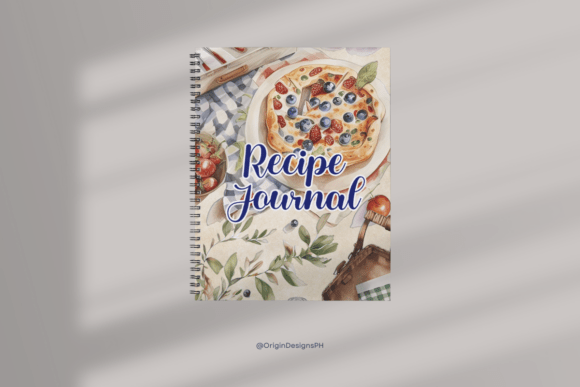
Recipe Journal: Your Culinary Legacy, Organized
There’s a quiet urgency in every kitchen where a grandmother’s handwritten note slips from a worn index card—or where a beloved sauce recipe vanishes after a phone update. That moment isn’t just about losing instructions; it’s about losing voice, intention, and lineage. The Recipe Journal meets that need—not as a generic notebook, but as a thoughtfully structured tool designed for clarity, consistency, and continuity.
At its core, the Recipe Journal is an A5-format digital template built for printing. It’s not software, not an app, not a cloud-based platform vulnerable to login errors or algorithm changes. It’s a clean, printable framework—designed once, used for decades. You fill it with your own handwriting, paste in clippings, sketch technique notes, or leave space for photos of finished dishes. Because it’s meant to be printed, it stays under your control: no subscriptions, no syncing failures, no third-party terms governing access to your family’s food history.
More Than Pages—A System for Meaningful Capture
What makes the Recipe Journal distinct isn’t just its aesthetic—it’s its intentional architecture. Each spread includes dedicated space for:
- Origin story — Who taught you this? Where were you when you first made it?
- Ingredient notes — Not just measurements, but substitutions that worked (or didn’t), seasonal swaps, pantry shortcuts.
- Process annotations — “Stir clockwise only,” “Rest dough in the coldest drawer,” “Add lemon zest *after* cooling”—details that turn technique into tradition.
- Tasting log — Date, occasion, who was there, what felt right (or off) — turning meals into memory anchors.
This structure does two practical things: First, it surfaces nuance you’d otherwise forget. Second, it trains future users—your kids, students, cooking club members—to observe, reflect, and adapt—not just follow.
Creative Applications Across Roles
Different creators use the Recipe Journal in ways that match their goals—not as a rigid form, but as a flexible scaffold.
For Educators & Cooking Instructors
A culinary teacher in Portland uses printed copies as student workbooks. Learners document their first sourdough bake across three weeks—recording hydration shifts, ambient temperature, starter behavior, and crumb photos. The journal becomes both assessment tool and confidence builder: students see progress in real time, not just grades.
For Content Creators & Bloggers
A food photographer in Nashville prints one journal per seasonal project—say, “Summer Tomato Archive.” She logs each variety tested (Brandywine, Cherokee Purple, Green Zebra), notes peak ripeness windows, pairs with herbs grown onsite, and sketches plating ideas. Later, those pages become the backbone of a well-organized Instagram series and a cohesive e-book—no scrambling to reconstruct context from scattered notes.
For Small Business Owners
A bakery owner in Asheville adapts the journal to track signature recipes across iterations: “Maple Pecan Loaf v.1–v.7.” Each version includes cost-per-unit, customer feedback snippets (“Too dense for afternoon tea”), and shelf-life tests. When training new bakers, she hands them the journal—not a static PDF—but a living record of decisions, not just outcomes.
Practical Tips for Consistent, Lasting Use
Starting is easy. Staying consistent is harder. Here’s how creators keep the Recipe Journal active—not archived:
- Anchor it to a habit — Pair journaling with your post-dinner cleanup. Five minutes while the kettle boils. No pressure to finish—just one dish, one observation.
- Use physical cues — Keep a pen clipped to the journal’s spine. Store it beside your favorite apron or next to your spice rack—not buried in a drawer.
- Batch-print quarterly — Print four journals at once, label spines with seasons (“Spring 2024,” “Holiday 2024”), and treat each like a contained chapter—not an endless scroll.
- Leave room for imperfection — Smudged ink, coffee rings, crossed-out lines? Those aren’t flaws—they’re proof of use. This isn’t a portfolio piece. It’s working documentation.
Platform-Smart Publishing (Without Breaking Terms)
You’re allowed to sell printed hard copies—and that opens smart, low-risk paths to reach new audiences. On Amazon KDP, list it as a “recipe logbook for home cooks and food historians,” emphasizing its A5 size, printable nature, and heirloom framing. On RedBubble, pair it with minimalist kitchen-themed art—positioning the journal as part of a curated lifestyle, not just a utility.
Crucially: never distribute the digital file. Never bundle it as a free download with another product. Never upload the PDF to a membership site for members to print themselves. Those actions violate usage rights—and more importantly, dilute the journal’s purpose: to be a deliberate, owned object. Printed copies preserve intent. Digital files invite fragmentation.
Why Tangibility Still Matters
In a world of disappearing links and auto-deleted drafts, the Recipe Journal offers something quietly radical: permanence through simplicity. A printed page doesn’t require Wi-Fi, battery life, or account recovery. It fits in a drawer, sits on a shelf, gets passed down—not migrated, not synced, not updated.
That’s why designers choose it for client gifting (tucked inside a handmade ceramic bowl), why educators use it in intergenerational workshops (grandparents and teens filling adjacent pages), and why small publishers feature it in “slow living” catalogs—not as nostalgia bait, but as functional resistance to digital overload.
Your culinary legacy isn’t defined by perfection. It’s defined by presence—the attention you pay to flavor, to timing, to who’s at the table. The Recipe Journal doesn’t ask you to write a memoir. It asks you to write down what happened today—so tomorrow, someone can taste it too.