2026 Planner – Winter Berry Notes
If you’re someone who values intentionality over inertia—whether you’re launching a side project, managing client deadlines, balancing family commitments, or simply trying to reclaim mental space—the 2026 Planner – Winter Berry Notes offers a grounded, no-frills approach to planning that stands out in a crowded digital marketplace. It’s not another feature-heavy app clone or an overly decorative journal designed more for Instagram than actual use. Instead, it’s a thoughtfully structured A5 digital planner built for clarity, consistency, and quiet confidence in daily execution.
A Purpose-Built Layout, Not Just Pretty Pages
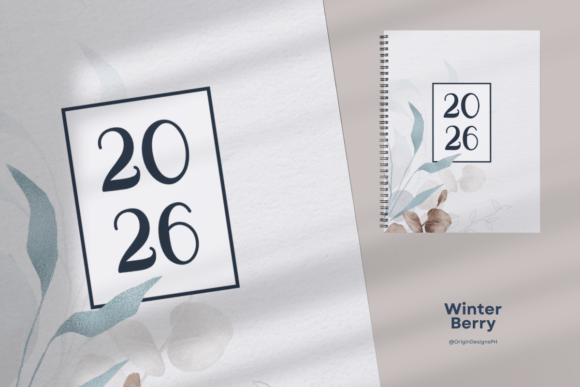
The 2026 Planner – Winter Berry Notes centers around simplicity with intention. Its one-side-print-only design eliminates visual clutter and gives users ample room to write, sketch, annotate, or reflect without feeling constrained by cramped margins or competing columns. The 2026 calendar overview provides immediate context, while the monthly and weekly spreads offer balanced structure: enough guidance to orient your priorities, but enough white space to adapt as real life unfolds.
This isn’t a planner that assumes you’ll follow rigid time-blocking or habit-tracking systems. It accommodates varied workflows—whether you prefer bullet-style notes, long-form reflection, deadline mapping, or hybrid scheduling. The “Goals” and “Dates to Remember” sections aren’t afterthoughts; they’re integrated early, encouraging forward-looking thinking without demanding perfection. Users report that this layout reduces decision fatigue at the start of each month or week—especially helpful for freelancers juggling multiple clients or educators aligning lesson plans with administrative calendars.
Digital-First, Print-Flexible Design
As a digital product, the 2026 Planner – Winter Berry Notes is delivered as a high-resolution PDF optimized for printing on standard A5 paper or compatible notebooks. There’s no software dependency, no subscription, and no learning curve beyond opening a file and choosing your print method. That makes it especially useful for professionals who prefer tactile planning but want the convenience of digital distribution—or creators who need flexibility across fulfillment channels.
The licensing terms are clear and commercially practical: you may sell printed hard copies through platforms like Amazon KDP, Printful, Printify, Gelato, or RedBubble, provided customers receive only physical versions. You may not redistribute the digital file itself—no email giveaways, no bundled downloads, no resale as a standalone PDF. This protects both the creator’s IP and the integrity of the product’s value proposition: a premium-feeling, affordable physical tool—not a disposable digital asset.
Who Benefits Most—and When?
The 2026 Planner – Winter Berry Notes serves best those who prioritize function over flash. Consider it if:
- You’re a small business owner or solopreneur managing quarterly goals, tax deadlines, and client milestones—all within one cohesive timeline;
- You’re a content creator or educator building a 2026 content calendar and need space to map themes, deadlines, and resource needs without switching between apps;
- You’re a marketer or project manager coordinating cross-functional teams and want a lightweight, printable reference that complements—not competes with—your existing tools;
- You’re a serious hobbyist (e.g., writers, gardeners, makers) tracking seasonal rhythms, skill-building timelines, or personal challenges over the full year.
It’s less suited for users seeking automated reminders, cloud sync, or AI-assisted planning. Nor does it include templates for complex project management (e.g., Gantt charts or Kanban boards). Its strength lies in its restraint: it supports human judgment, not algorithmic direction.
Real-World Usability and Long-Term Fit
In practice, users appreciate how the A5 size fits comfortably in most bags and on desks without dominating workspace. The one-sided printing allows for easy binding, hole-punching, or integration into disc-bound systems—making it adaptable to personal organization ecosystems. Because it’s uncluttered, it avoids the common pitfall of planners that feel overwhelming before you’ve even filled in January 1st.
Quality hinges on your print setup. When printed on 100–120 gsm paper, the soft “Winter Berry” color palette remains warm and legible without bleeding. Lighter stocks may show through slightly on reverse pages—but since it’s single-sided, that’s rarely an issue. Some users add their own tabs or highlight key dates with washi tape or colored pens, reinforcing its role as a collaborative tool between planner and user—not a static artifact.
Long-term value emerges from consistency. Unlike apps that change interfaces or require updates, this planner remains stable across devices and years. You can archive past versions, compare annual progress, or reuse layouts across cycles. Educators, for example, often keep prior-year planners to refine syllabi or adjust pacing based on real student engagement—not theoretical timelines.
Practical Considerations and Limitations
Because it’s digital-only upon purchase, access depends on your ability to download, store, and print the file. Those without reliable printers or who rely heavily on mobile annotation may find it less convenient than tablet-optimized planners (though many use it successfully with stylus-friendly PDF readers and external Bluetooth keyboards).
The absence of pre-filled holidays or regional observances means users must manually note local deadlines, school breaks, or cultural events—a small trade-off for global flexibility. Similarly, while the “Dates to Remember” section is useful, it doesn’t auto-populate recurring entries like birthdays or subscriptions; that responsibility stays with the user, which suits intentional planners but may frustrate those wanting automation.
Finally, because it’s licensed for printed resale only—not digital redistribution—it won’t work for coaches or course creators who bundle planning tools into paid digital programs unless they convert each page to a printed format first. That constraint ensures quality control but requires logistical planning for commercial users.
Making 2026 Your Best Year Yet—Without the Overwhelm
The phrase “make 2026 your best year yet” isn’t marketing fluff here—it’s an invitation rooted in design discipline. The 2026 Planner – Winter Berry Notes doesn’t promise transformation through sheer volume of features. Instead, it supports steady progress through thoughtful scaffolding: space to define what matters, structure to revisit it regularly, and flexibility to adjust when priorities shift.
For professionals who’ve cycled through planners that either under-deliver on usability or over-promise on functionality, this one earns trust through consistency—not hype. It works well alongside digital calendars (for reminders) and task managers (for delegation), filling the gap where reflection, intention-setting, and analog rhythm matter most. And because it’s priced accessibly despite its premium aesthetic, it removes cost as a barrier to starting strong in 2026—without sacrificing substance for speed.
If your goal isn’t just to fill time, but to shape it with care, the 2026 Planner – Winter Berry Notes offers a quietly capable foundation—one page, one week, one season at a time.