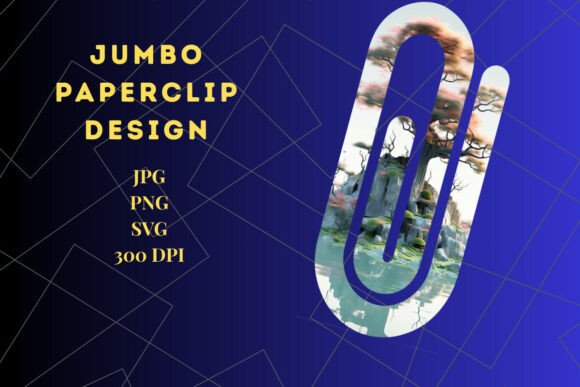
Jumbo Paperclip Design – Zen Garden
You’ve seen it before: a clean, modern layout that almost works—until something’s missing. Not more text. Not another font. Just a subtle, intentional detail that grounds the design and quietly says, “This was made with care.” That’s where the Jumbo Paperclip Design – Zen Garden steps in—not as decoration, but as a functional accent with presence.
It’s a digital paperclip—but not the kind you’d find in a drawer. This one is oversized, thoughtfully shaped, and rendered with the soft, meditative balance of a Japanese rock garden: smooth curves, balanced weight, and a quiet elegance that avoids clutter. Its form nods to tradition while feeling unmistakably current—ideal for creators who want visual cohesion without sacrificing personality.
Where this paperclip lives—and why it matters
Unlike generic clip art, the Jumbo Paperclip Design – Zen Garden was built for context. It doesn’t shout. It holds space. You’ll reach for it when designing a workshop handout for your community gardening group—not because you need a clip, but because its shape echoes the calm focus of tending soil, pruning branches, or arranging stones. It fits naturally on a wellness newsletter header, a mindfulness journal cover, or even a small-batch tea label—anywhere you want to signal intentionality without words.
Freelance designers use it as a compositional anchor: pinning a quote to the corner of an Instagram carousel, securing a testimonial snippet over a neutral background in a client presentation, or framing a key metric in a quarterly report for a sustainability startup. It’s not just “placed”—it’s used. Like a real paperclip, it implies connection, organization, and gentle emphasis.
Real uses—no hypotheticals
Educators drop it into Canva lesson plans to visually “clip” learning objectives to the top of a slide—especially in SEL (social-emotional learning) units about balance, reflection, or growth. One middle-school art teacher told us she prints it at 4” wide on kraft paper, cuts it out, and uses it as a tactile prompt during classroom reflection circles: “What are you holding onto right now?”
Small business owners embed it into product mockups—not as a standalone graphic, but as part of the scene. A ceramicist adds it to a flat-lay photo of handmade mugs and sketchbooks; a yoga studio overlays it lightly on a schedule PDF so class times feel curated, not scheduled. It signals craftsmanship, not just convenience.
Bloggers and content creators use the SVG version to animate subtle motion in Lottie or After Effects—a slow, gentle rotation as a page loads, or a soft hover effect on a “download guide” button. Because it’s vector-based and 300 DPI, it scales cleanly from mobile thumbnails to printed zine inserts without pixelation or reworking.
Why “Zen Garden” isn’t just a name
The design’s minimalism isn’t about stripping things away—it’s about honoring what remains. The curve of the loop mirrors the arc of a raked sand pattern. The slight taper in the arms echoes the careful placement of moss or stone. That intention translates directly to how people interact with it: no one drags it in just to fill white space. They pause first. They consider alignment, contrast, breathing room.
That’s why it works so well in high-trust environments—therapy practice websites, nonprofit annual reports, academic syllabi. It doesn’t compete with serious content. Instead, it supports it—like a quiet nod during a conversation that says, “I’m listening. I’m here.”
What to keep in mind before using it
Because it carries tone so clearly, pairing matters. Avoid dropping it onto chaotic layouts, neon gradients, or fonts with aggressive serifs—those clashes dilute its grounding effect. It thrives with ample whitespace, muted palettes, and typefaces that breathe: think Inter, Lora, or even a carefully chosen handwriting style.
Also, remember its scale. “Jumbo” means it’s meant to be seen—not tiny in the corner, but purposefully sized. Try it at 15–20% of your canvas width in digital work, or 2.5–3 inches wide in print. If it feels like an afterthought, it’s probably too small.
And while it’s offered in JPG, PNG, and SVG, choose deliberately: use PNG for layered digital composites (transparency included), SVG for responsive web use or animation, and JPG only if embedding into non-editable PDFs or email templates where vector support is unreliable.
Who benefits most—and how
Hobbyists building printable planners or gratitude journals often overlook how much tone a single repeated element can set. The Jumbo Paperclip Design – Zen Garden becomes their quiet signature—clipping weekly intentions, marking seasonal reflections, or anchoring habit trackers. It turns personal documentation into something tender and consistent.
Marketers at mission-driven brands use it to soften data-heavy assets—like clipping a short impact stat to a donor report graphic, or securing a values statement to the footer of a campaign landing page. It signals that numbers and purpose aren’t separate—they’re held together, intentionally.
Procreate users love the PNG version for custom brush textures: they import it as a layer, apply grain or watercolor blending, then stamp it across digital sketchbook pages—adding tactile rhythm without losing clarity. One illustrator even traced it into a custom stamp brush for quick, repeatable accents in client pitch decks.
A note on versatility—without overpromising
This isn’t a “one-size-fits-all” asset. It won’t jazz up a loud tech promo or replace bold typography in a festival poster. But where calm, clarity, and considered design matter—whether you’re prepping a grant application, launching a mindful subscription box, or designing a quiet corner of your portfolio—it adds weight. Not flash. Not noise. Just presence.
It’s also free—not as a trial, not with attribution required, not locked behind email capture. That matters. When you’re juggling client revisions, lesson prep, or launch deadlines, frictionless access means you spend less time hunting and more time making.
So yes—it’s a paperclip. But like the best tools, its value isn’t in what it is. It’s in how it helps you hold things together, gently, meaningfully, and with room to breathe.